Life Savers
Terry Donnelly
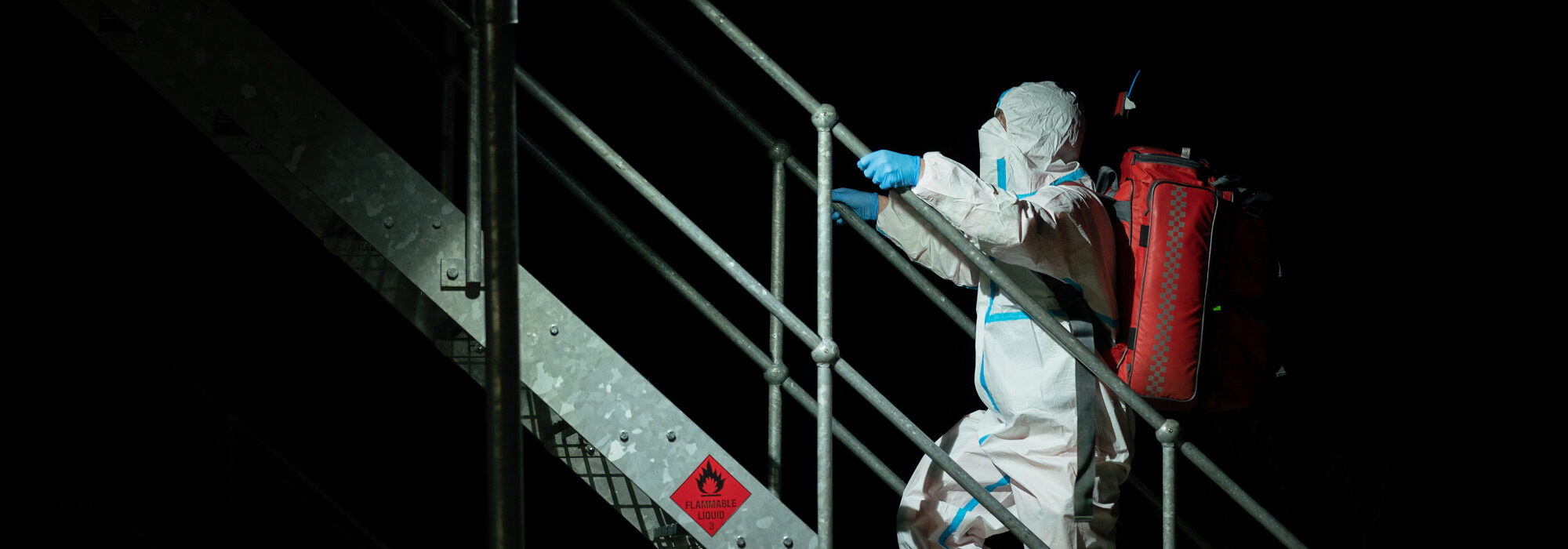
Funded through donations and public support, Wiltshire’s air ambulance is a huge, demanding and complex service – but add in a global pandemic that complicates its work and its funding, and that job becomes harder still. That’s the story that photographer Terry Donnelly wanted to tell.
 © Terry Donnelly | Sony α9 II + FE 85mm f/1.4 GM | 1/80s @ f/1.4, ISO 2500
Documenting how Wiltshire Helicopter Emergency Medical Service (HEMS) was adjusting to the pandemic, Terry shot with them through gruelling 16 hour days. “There’s never any downtime,” he says, “and they do such a physically and mentally demanding job, that it felt very important for me to photograph it. The Covid PPE is vital, but it also inhibits the physical and communication sides of the job, especially when you’re trying to deal with a disoriented patient. People need to know the challenges the professionals faced and how they went on saving lives.”
 © Terry Donnelly | Sony α9 II + FE 85mm f/1.4 GM | 1/100s @ f/1.4, ISO 1600
“The constant state of readiness meant I needed to be weighed every morning with my camera kit so the pilot could accurately gauge the fuel needed,” Terry explains, “and I kept my Sony gear on me at all times. But like the aircrew and paramedics, I was also kitted up in PPE, which creates all sorts of difficulties. Strapped into the aircraft with a four-point harness, visor and comms kit, there were some real challenges to picture taking, and of course you want to keep your presence almost invisible, too. Nothing can get in the way of the paramedics’ task.”
 © Terry Donnelly | Sony α7C + FE 50mm f/2.5 G | 1/640s @ f/2.5, ISO 125
With no second chances, Terry was reliant on his Sony Alpha gear, and it didn’t let him down. “I shot with both the Alpha 9, Alpha 9 II and a couple of Alpha 7C bodies,” he explains “and the latter were particularly important when I was moving around a lot or working in the confined spaces of the helicopter whose call sign is HELIMED22. The full frame image quality you get from cameras that light is amazing, and especially so when combined with new G Compact lenses. I used the FE 24mm f/2.8, FE 40mm f/2.5 and FE 50mm f/2.5, and I certainly got pictures which I wouldn’t have with larger, heavier gear. Those lenses are great focal lengths for documentary work, they focus fast, and let a lot of light in when you need it.”
 © Terry Donnelly | Sony α9 + FE 12-24mm f/2.8 GM | 1/3200s @ f/4.0, ISO 1600
Also important to Terry’s project were features like In-Body Image Stabilisation (IBIS), Real-time Eye AF and Silent Shooting. “IBIS made a huge difference for low-light shots,” he explains, “and it let me use slower shutter speeds to pick up movement in the helicopter’s rotors. But the silent shutter and eye detection AF were absolutely vital around the fully equipped paramedics. Using Eye AF mode meant I could shoot at the widest apertures and easily focus through visors, windows and goggles, when otherwise the focus might have slipped, while the silent shutter meant I was never intrusive or distracting for the crew, even working right beside them.”
 © Terry Donnelly | Sony α7C + FE 24mm f/2.8 G | 1/100s @ f/22, ISO 320
All those things and the confidence they bring,” he continues, “free you up as a photographer. If you're shooting with kit that doesn't perform, it breaks that connection and you start looking at the screen and checking if you got the shot, so the flow is lost. I was there to tell a story and make that connection, and that’s what these cameras allow you to do.”
 © Terry Donnelly | Sony α9 II + FE 135mm f/1.8 GM | 1/2500s @ f/1.8, ISO 100
 © Terry Donnelly | Sony α7C + FE 50mm f/2.5 G | 1/320s @ f/2.5, ISO 100
The images Terry feels best showed the task of the aircrew include these powerful portraits of paramedic, Joanne Gilbert, with marks on her face from the PPE equipment, and pilot ‘Elvis’ Costello framed by the reflection of HELIMED22 in his office window. “These shots,” he explains, “have the elements that tell the Covid story, like the PPE equipment, but also capture their personality and the challenges they were under. Jo has gone from a happy, bubbly person at the start of her shift, to someone who’s more serious and whose face is adorned with marks from wearing PPE equipment as she’s gone about her life saving duties. And with ‘Elvis’, he’s constantly vigilant, responsible for all his crew and the life they’re trying to save.”
 © Terry Donnelly | Sony α9 + FE 12-24mm f/2.8 GM | 1/100s @ f/14, ISO 100
Ultimately, it was telling that story in full that gave Terry the greatest pleasure. “Photography gives you a sort of platform,” he finishes, “and the capacity to share what’s important to you; the stories that really matter. Everyone has struggled in some way this past year, but we need to keep essential services like our air ambulances going through donations. We never know when someone’s life will depend on them. I’ve seen the incidents they attend and their story needs telling so that we never ever take them for granted, and I’m glad that I was able to tell it.”
 © Terry Donnelly | Sony α7C + FE 50mm f/2.5 G | 1/40s @ f/2.5, ISO 1600
Featured products


Terry Donnelly | UK
"Although I shoot different genres of photography I find a cross over of skill set between them which makes my work stronger"


