
Shoot for the Moon
René Ringnes
The moon has fascinated humanity for as long as there have been humans to fascinate. Its influence is writ large in mythology, storytelling and art – and of course photographers like Norway’s René Ringnes aren’t immune to its charms either. “I’ve always been enchanted by the moon,” René begins, “and actually, my career in photography was inspired by shooting it. Watching a full moon appear from behind the horizon is as beautiful as a sunrise – and it’s those moments that I want to share.”
However, always in motion, small in the sky and with a clear view subject to the vagaries of geography and weather, the Earth’s only natural satellite can be difficult to capture. Or at least difficult to do so in a way that replicated the drama its spectators feel.
When it comes to shooting, René has a particular trick up his sleeve. “I never want pictures of just the moon alone in the sky,” he says. “To make it striking, I always place it in perspective with something else. A nice foreground gives the moon context and, if you use the right focal lengths, the combination makes it seem larger and more impressive. So as the moon crests over or dips beneath the horizon, I compose it behind buildings, people, landmarks, or other reference points.”
 © René Ringnes | Sony α7R IV + FE 100-400mm f/4.5-5.6 GM OSS | 1/125s @ f/5.6, ISO 1250
With the moon only crossing the horizon for a few moments each day before it gets too high to interact with the foreground – or too low to be seen – some planning is needed. “First I find the subject that I want to place in front of the moon,” René explains, “then I use an app to find out exactly where I need to stand and what time I need to shoot. The further you are away from the foreground of the moon, the bigger the moon will appear in comparison.”
Having found the perfect spot, René says focal length and resolution are instrumental in success. “If you’re going to get spectacular pictures of the moon, the equipment has a lot to say. I use a Sony camera with a very high resolution – the Alpha 7R IV – and that means I can crop the image afterwards without compromising the quality, letting me fill the frame even more with the moon. But maybe even more important is the lens that you use. For me, the 100-400mm GM has been vital for my lunar photography.”
“For the photos I want to make, 400mm is the minimum really,” he continues. “That kind of magnification is needed if you want to make the moon look big. Depending on my distance from the foreground – which could be anything from a few hundred metres to several kilometres – I also fit the Sony FE 2x Teleconverter, which gives me up to 800mm.”
 © René Ringnes | Sony α7R IV + FE 100-400mm f/4.5-5.6 GM OSS | 1/160s @ f/5.6, ISO 800
“As a G Master lens, the FE 100-400mm gives very high-quality images and the level of sharpness means that it becomes more and more fascinating as you zoom into the image afterwards,” he says. The lens’s Optical Steady Shot also plays a part here too, meaning that details are crisp even when hand holding or shooting from a monopod.
Out on location, Rene also feels the benefits of the lens’s size, weight and handling. “All of Sony’s premium G Master lenses are fantastic,” he glows, “and the 100-400mm is no exception. Portability is important too if, like me, you’re moving around to get the angle on the moon that you’ve dreamed of. I was amazed by how light and small it was when I held it for the first time.”
With fast and sure focusing, René can also rely on lunar details being crystal clear and of course, just as the FE 100-400mm’s focal length magnifies the moon, it also exaggerates the satellite’s progress across the sky. “To the naked eye, the moon may seem to hang motionless in the sky, but when enlarged, you’ll notice how quickly it moves,” René confirms, “and especially so when using a focal length of 400mm or more. Therefore, shutter speed has a lot to say in success. The images here were shot at between 1/125sec and 1/160sec, a lot faster than you might expect for a low-light situation.”
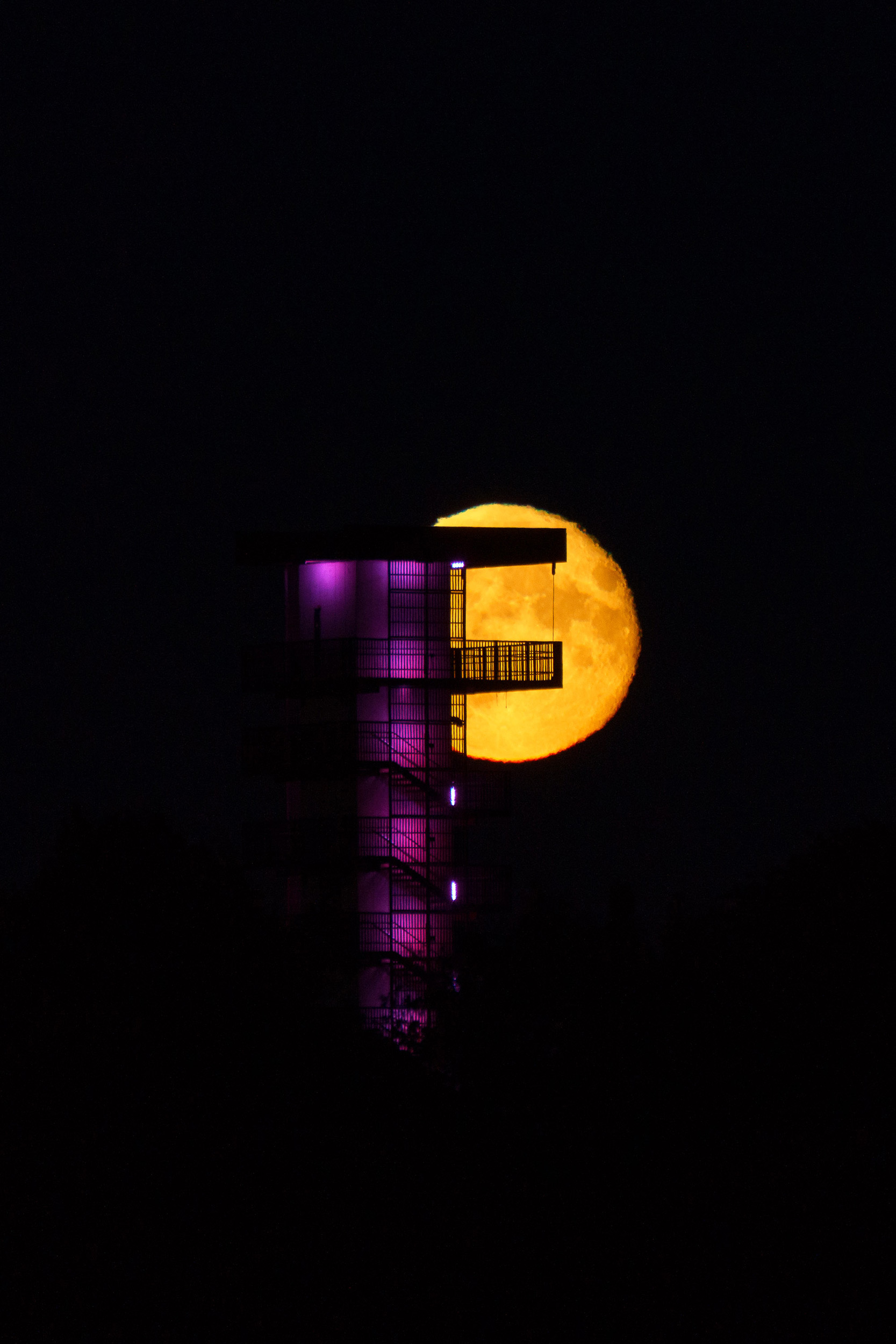 © René Ringnes | Sony α7R IV + FE 100-400mm f/4.5-5.6 GM OSS | 1/125s @ f/5.6, ISO 1250
And just like the moon, René feels his photography is constantly in motion. “Like any creative, I want to keep topping the photos I've taken so far,” he finishes, “so I know I have to find exciting new subjects and come up with fresh ideas. When it comes to shooting the moon, patience and planning always pays off and they’re something I work for every single day. I’m just thankful that when the planning comes together, I have my Sony gear to take advantage.”


