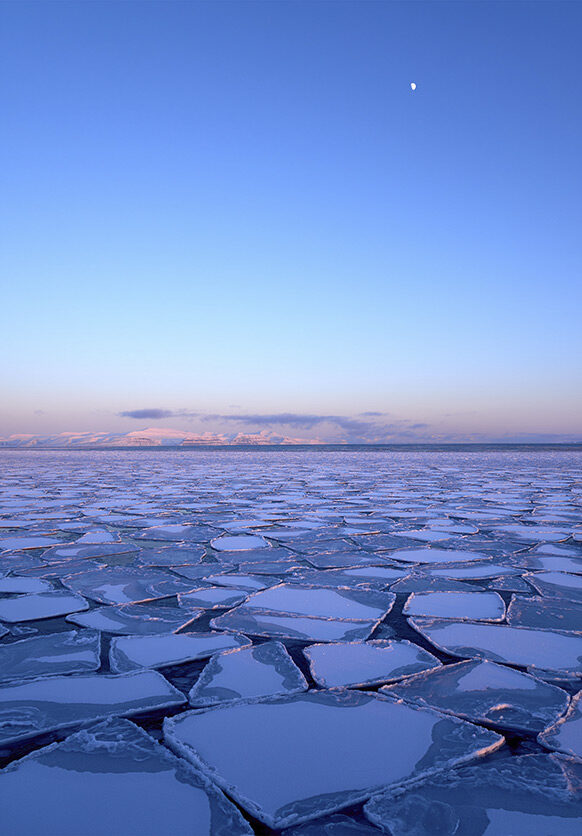
Sand and Snow
Marco Ronconi
Born during the isolation of the pandemic in 2020, Marco Ronconi’s ‘Hueco Mundo’ project is a beautiful study of the similarity between two of the world’s harshest environments. Marco has been shooting the project with his Sony Alpha 1 and Alpha 9, the best cameras for shooting in extreme environments.
 © Marco Ronconi | Sony α1 + FE 100-400mm f/4.5-5.6 GM OSS | 1/1000s @ f/8.0, ISO 320
“The idea for the project was formed during the pandemic. I wanted to escape mentally and imagined travelling to these locations and scenes I would capture. As soon as I could, I travelled and made the images I had seen in my mind a reality.” says Marco.
Marco travelled to two deserts in the Arctic. These places are about as far removed as we could imagine, yet Marco found a striking similarity in their physical structure and the sense and feeling created by the environment.
 © Marco Ronconi | Sony α1 + FE 100-400mm f/4.5-5.6 GM OSS | 1/2000s @ f/5.6, ISO 320
“These two opposite places are more similar than we could ever imagine. The climate and the temperature may be very different, but there was a similarity in terms of the emptiness and the peace. The spaces have a therapeutic effect on my soul,” says Marco. “That peace was something I was looking for. It was mental healthcare for me.”
 © Marco Ronconi | Sony α1 + FE 70-200mm f/2.8 GM OSS II | 1/640s @ f/5.0, ISO 1600
At home, Marco rarely picks up his camera; “I’m not an everyday shooter. I will shoot a lot on a trip and may not pick up my camera for months afterwards. Whenever I pick up my Alpha 1, I don’t have to think about the camera. Once the memory card is inside and the batteries are charged, I know it will work as I want.”
Marco’s trust in his Alpha 1 gives him the confidence to shoot in extreme environments. “In Svalbard, it was -35ºC, but everything always worked fine”, he reveals, “and it is the same in the heat.”
 © Marco Ronconi | Sony α1 + FE 70-200mm f/2.8 GM OSS II | 1/640s @ f/5.0, ISO 640
Like many other photographers adventuring to distant places, Marco packs only what he needs, yet he must prepare for various situations. “I am a very simple guy”, he jokes, “I almost always use zoom lenses – the FE 24-105mm f/4 G OSS, the FE 70-200mm f/2.8 GM OSS II lens and I have recently added the FE 100-400mm f/4.5-5.6 GM OSS. Finally, I have the FE 20mm f/1.8 G lens. My work is all about composition, so using zoom lenses, I sacrifice a tiny bit of quality compared to using prime lenses. However, a little sacrifice allows me to have more flexibility in my composition. I am shooting at smaller aperture settings, so I don’t need the large apertures that the expensive prime lenses offer. Depending on what I plan to shoot, I pack two camera bodies and two or three lenses, and everything fits in a small backpack”.
The barren deserts of snow and sand in Marco’s ‘Hueco Mundo’ book project provide the perfect graphic backdrop for the key elements of each image.
 © Marco Ronconi | Sony α9 + FE 24-105mm f/4 G OSS | 1/4000s @ f/9.0, ISO 800
“It is very minimalistic in terms of colour palette and imagery”, says Marco, “For a long time, I’ve been inspired by traditional ink paintings from Japan or China, which show few elements and are very monochromatic. I also studied Eastern philosophy, which reflects in my work. In the East, the concept of emptiness is very different. It is a fundamental part of an image or a piece of music. In the West, ’emptiness’ is seen more as something negative, as though something is missing. I believe space and emptiness are essential to any artistic composition.”
 © Marco Ronconi | Sony α1 + FE 70-200mm f/2.8 GM OSS II | 1/800s @ f/5.0, ISO 640
To create his minimalistic graphic images of the animals in their habitat, Marco will push the exposure of his shots as much as possible. A blanket of snow becomes an almost solid white background in many of Marco’s pictures. The feature that makes this possible is the Alpha 1’s electronic viewfinder. “Once you have tried it, you cannot go back”, he says of the EVF. “The exposure simulation it provides is essential to me. I tend to overexpose my images when shooting in the snow to get that very bright graphical image. The EVF allows me to preview the final image to check I have the correct exposure and haven’t burnt out any details.”
 © Marco Ronconi | Sony α1 + FE 70-200mm f/2.8 GM OSS II | 1/800s @ f/5.0, ISO 1600
There are so many incredible images within ‘Hueco Mundo’ that Marco doesn’t have a favourite photo. “It is why I don’t take part in competitions,” he reveals, “I’m more focused on the flow of my whole body of work rather than a single image”.
 © Marco Ronconi | Sony α1 + FE 70-200mm f/2.8 GM OSS II | 1/20000s @ f/5.0, ISO 800
However, Marco fondly looks back on some images from the moment he took them. “There is an image of an Arctic Fox running down a small hill. The light was beautiful, and ice particles and snow were blowing in the air.
It was a joyful, beautiful moment.”